Overview
Designing to change behaviour — not just report it
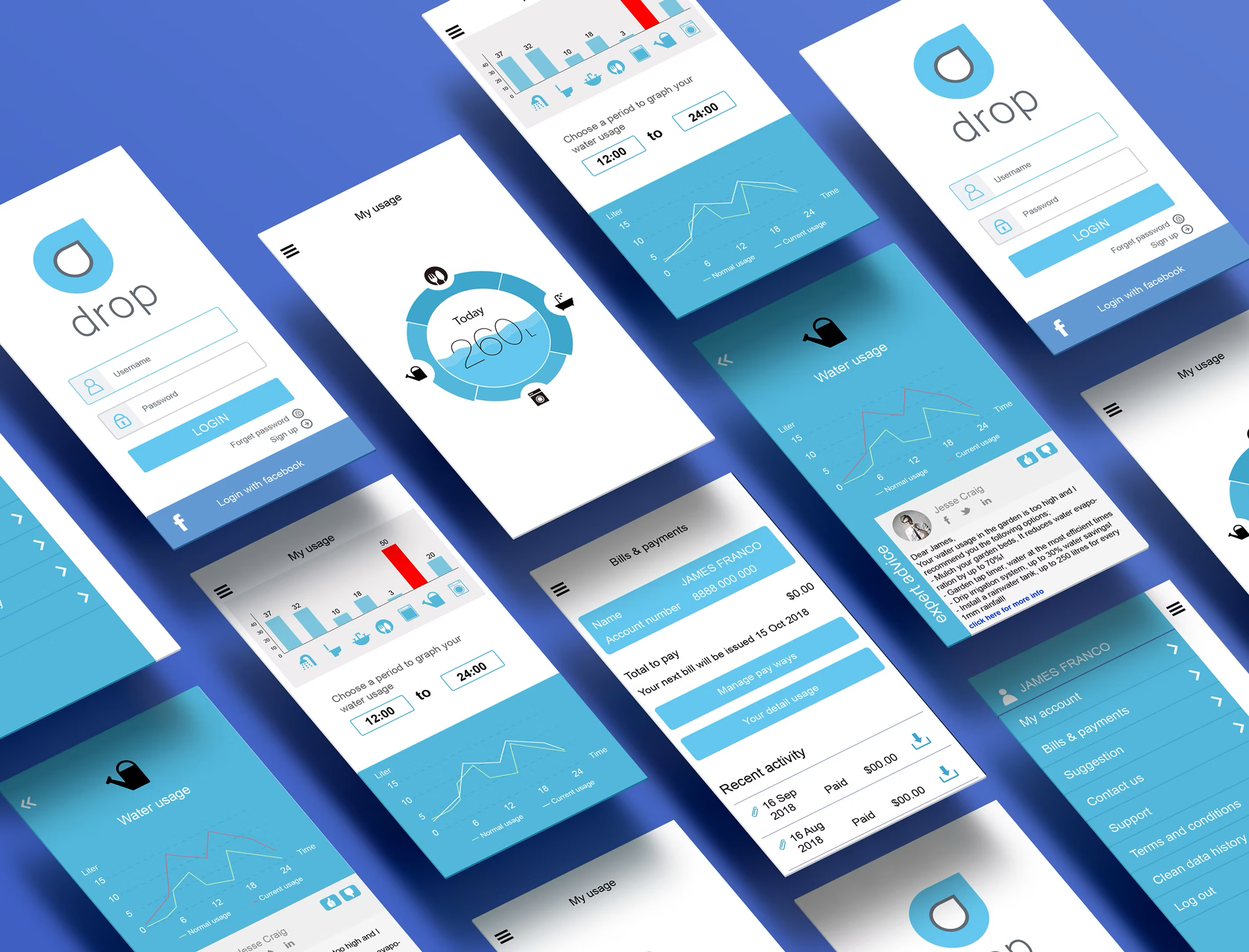
Drop is an eco-feedback mobile application designed to motivate household water conservation through real-time consumption data, gamification mechanics, and social comparison. Developed as part of the ITID Lab research programme, the project sat at the intersection of HCI research, behaviour change theory, and IoT — connecting a smart meter to a mobile experience that translated raw consumption data into something people would actually engage with.
This was an academic research project — not a commercial product. The design process was rigorous and documented, the outcomes were evaluated against behavioural hypotheses, and the work contributed to published research.
The Problem
Information alone doesn't change behaviour
The conventional approach to resource conservation is informational: tell people how much water they're using, and they'll use less. Research consistently shows this doesn't work in isolation. Knowing your consumption is high is not sufficient motivation to change entrenched daily habits — showering, washing dishes, running the garden — particularly when the cost feedback (water bills) arrives months later and feels disconnected from the behaviour.
Drop's premise was that eco-feedback, when combined with timely social comparison and meaningful rewards, could close the motivation gap that pure information cannot.
"Awareness is necessary but not sufficient. The design challenge is bridging the gap between knowing and doing — and that requires understanding what actually motivates behaviour change at a household level."
Research Grounding
Built on behaviour change theory
The design was grounded in established behaviour change frameworks — specifically Fogg's Behaviour Model (motivation × ability × trigger) and social norm theory. Each design decision was mapped against a theoretical rationale before prototyping began.
Real-time feedback
Connecting consumption to behaviour in near-real-time — not monthly bills. The IoT layer enabled moment-level data that made the link between action and impact legible.
Social comparison
Neighbourhood and household comparisons leveraging descriptive norm theory — "most of your neighbours use X litres per day." Framed positively, not punitively.
Gamification
Goals, streaks, and achievements designed to sustain engagement beyond novelty — the common failure point in eco-feedback applications.
Framing effects
Tested loss-frame vs gain-frame messaging in the app ("you've saved X litres" vs "you're wasting X litres"). Gain framing proved more effective at sustained engagement.
Design Process
Research → prototype → evaluate → iterate
Literature Review & Theoretical Framework
Reviewed eco-feedback and persuasive technology literature to establish a theoretical basis for design decisions — grounding the app in proven behaviour change mechanisms rather than assumed UX intuitions.
Contextual Research
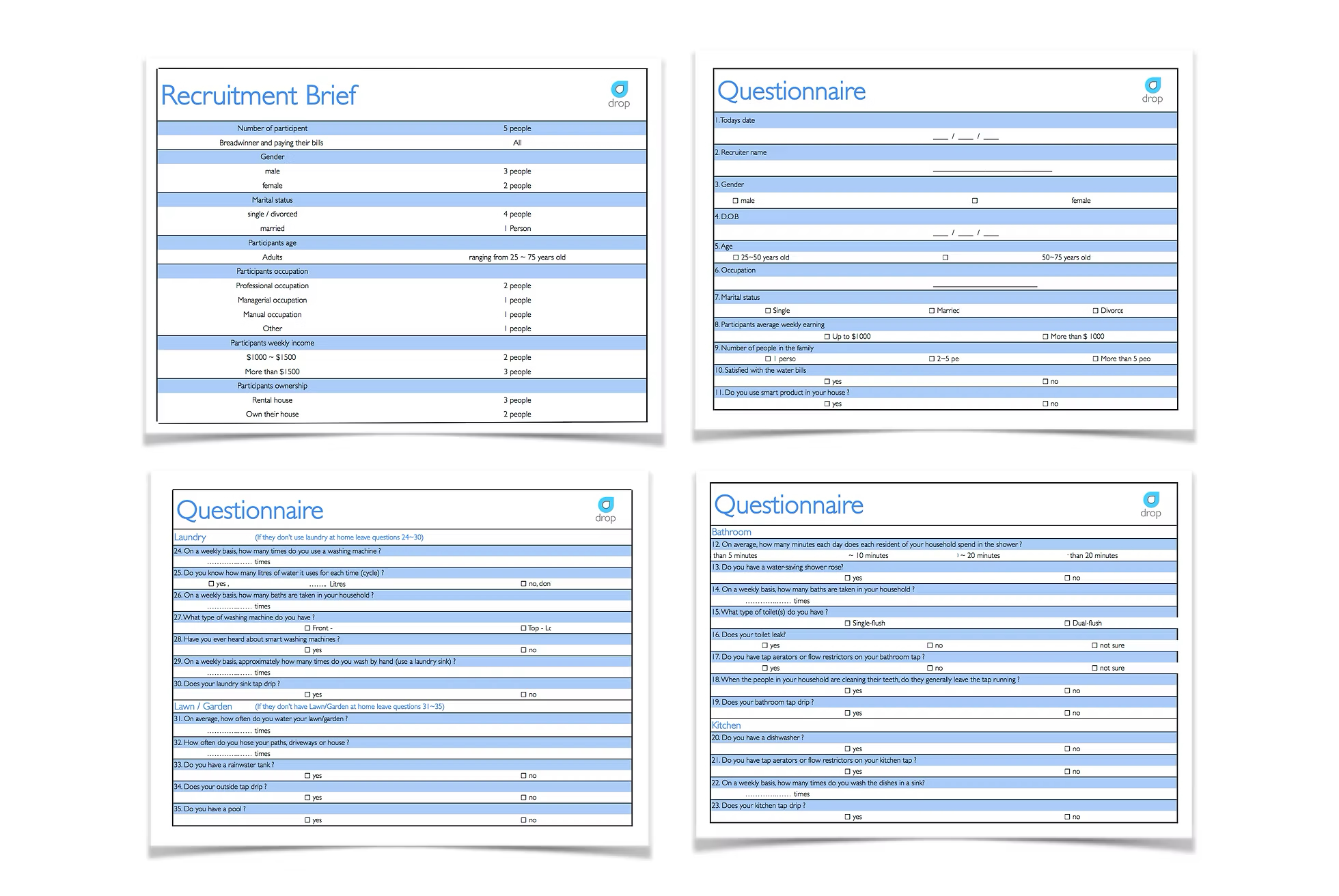
Conducted household interviews exploring existing water use habits, mental models of consumption, and attitudes towards conservation — establishing baseline behavioural profiles for the target user groups.
Iterative Prototyping
Three rounds of prototyping — paper, low-fi digital, high-fi interactive — each evaluated against specific hypotheses derived from the theoretical framework. Gamification mechanics were the most iterated element.
Field Study
Deployed the high-fidelity prototype with participants over a 4-week period, collecting both quantitative (consumption data from smart meters) and qualitative (diary studies, exit interviews) data.
Analysis & Write-Up
Analysed field study data against the initial behavioural hypotheses, producing a research report that contributed to the ITID Lab's published output on persuasive technology and sustainable behaviour.
Outcome
What we learned about designing for behaviour change
The field study demonstrated measurable engagement with the gamification elements and social comparison features — with participants reporting increased awareness of their consumption patterns. Actual consumption reduction varied by household, with the most consistent results in households where multiple members engaged with the app simultaneously.
The key finding that shaped subsequent research: eco-feedback applications tend to show strong initial engagement followed by significant drop-off. The design features that sustained engagement longest were social comparison and streak mechanics — not real-time data alone. Information is not enough. Social proof and continuity mechanisms are the difference between a week of curiosity and a month of changed behaviour.
Academic context: Drop was developed as part of the ITID (Interaction Technology and Innovation Design) Lab. This project represents academic research work — the methodology, rigour, and documented process are the deliverable, alongside the design artefacts produced.